
A Dancer Returns
Sarawanee Tanatanit's journey homeward, in search of something new

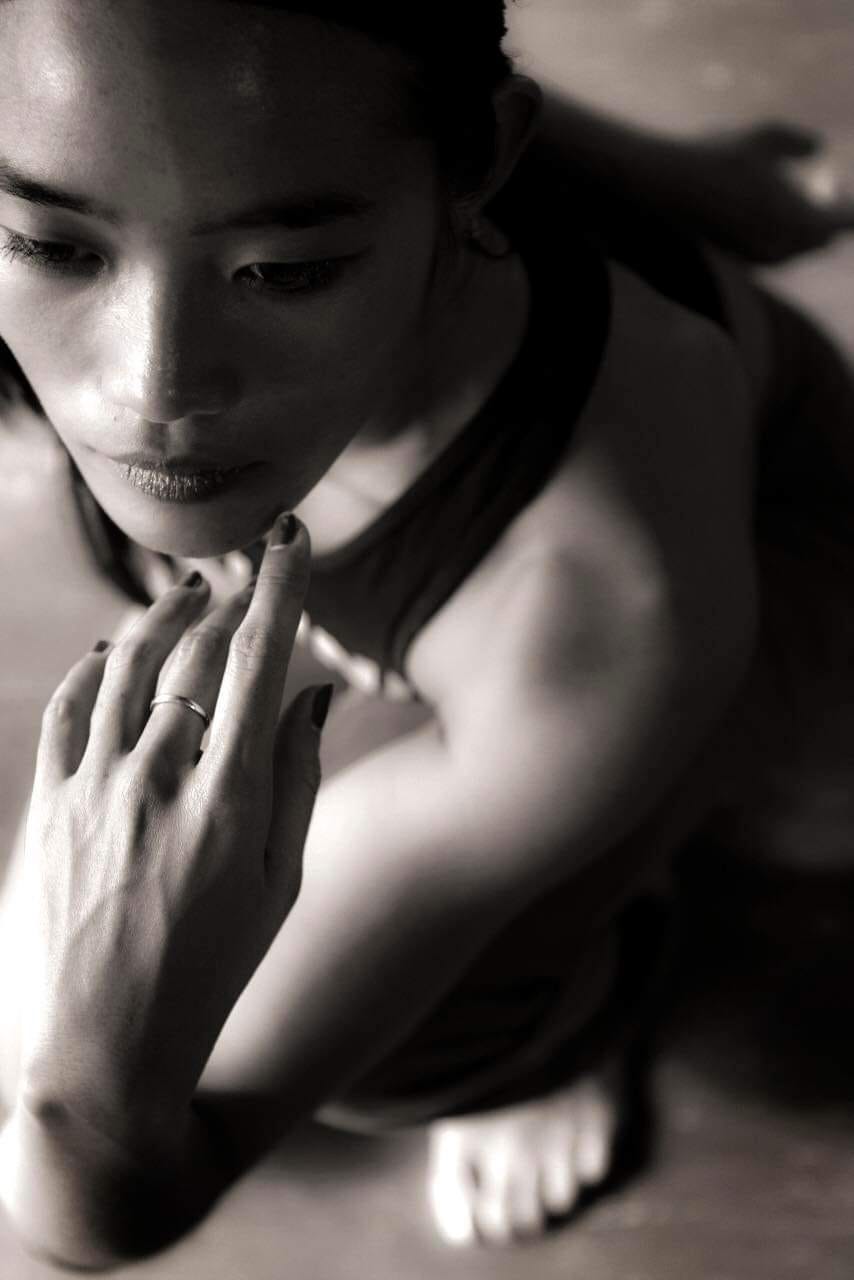
When in Bangkok, Sarawanee Tanatanit works a nine-to-five job, in dance studios, teaching.
This is what retirement has looked like so far for this former ballet dancer who spent seven years dancing for the American Ballet Theater and eight years with the Ballet du Grand Théâtre de Genève.
On the day of the interview, Sarawanee came right from teaching a class straight into the interview. Then, after a short break, she taught a one-on-one class to a 13-year-old ballerina who was in preparation for a dance competition abroad. Although she gave the interview in Thai, she spoke to her student in English, perhaps because English has always been the language of her dance life. The class lasted an hour and a half. She periodically asked her student whether she needed a break, but the young dancer only wanted to keep going.
Teenagers are her favorite age group to teach, something she recently realized. “It’s become clear to me this year that I’m good at teaching young dancers who want to take dance seriously,” she said. At that age, Sarawanee said, young dancers are “ready to get serious.”
After the private class, there was another group of dancers in their late teens waiting for their class with her in the semi-open-air area at Hostbkk Art Center, the multi-purpose art space that Sarawanee opened in late 2019. The venue stands tall atop the three-story building that houses the legendary Chandrphen restaurant. Sarawanee’s family has been running the establishment with other families for over 70 years. The restaurant has even played host to members of the Thai royal family.
Hosting a different crowd on the rooftop, Host, which stands for House of Sarawanee Tanatanit, has a decidedly sleeker and airier look than the three floors below.
A rough sketch of Host began forming in Sarawanee’s mind since she was in her 20s. “I knew I wanted to do something like this. I just didn’t know exactly what it would look like,” she said.
In 2017, after having left Ballet du Grand Théâtre de Genève and pursuing other dance projects, she began working on her vision for a space together with Thai architect Donya Veerasilpa. The entire space was built with dancers’ needs in mind and can be used as both performance spaces and dance studios. The two-story structure features one large performance space and studio on the lower level that seats up to 150 people and two smaller studios on the upper level, all fitted with sprung floors. On the lower level, there’s also a small air-conditioned room where parents sit and wait to pick up their children from classes and a semi-open-air space that is sometimes turned into a dining space or a bar.
The venue has hosted and been rented out for a range of artistic and social purposes. It was a site for performances and social events in Unfolding Kafka Festival and the Bangkok International Performing Arts Meeting (BIPAM), as well as small theater and dance productions, dance battles, an art exhibition, and more recently, a fashion show by a local designer.
Our interview took place in one of the two studios on the upper level of Host. Next door, one of the hip-hop dancers and artists-in-residence was rehearsing. Host’s annual month-long residency program, now in its second year, allows dance artists to use studio spaces at Host for free to develop their works and present them to the public. The young artists accepted into this year’s residency just presented their work-in-progress in early July.
When not teaching from morning till evening at Host, Sarawanee gets invited to judge dance competitions and to conduct dance workshops abroad. Between May and July alone, she was in New Zealand, Singapore, and Indonesia.
Sarawanee didn’t jump into teaching as soon as she quit dancing full-time. She furthered her education in dance and received a diploma in dance science from the University of Bern and a teaching diploma from the American Ballet Theater. She has taught all kinds of dance students from children to adults with no background in dancing to young dancers aspiring for a career in dance.
“At first, I didn’t teach that well because I didn’t love to teach. At that time, I loved dancing more, so I didn’t care for my students a hundred percent,” she said. “When I was an artist, I just did things for myself. I didn’t have to think about other people. I was selfish [laughs]. But when I have students, I have to care for other people. So there was quite a long period of adjustment,” she said.
But the way she perceives her role and purpose as a teacher has since become clearer to her. “I want to promote young dancers with talent. I train them hard here and send them abroad. And some have gone abroad, to New Zealand, to New York. I raise the standard of their dancing so they can become professionals.”
Sarawanee has been highly selective about hiring teachers to teach at Host. That’s why she’s been doing most of the teaching. She approaches teaching as a professional dancer transmitting her knowledge to students who want to become professional dancers.
“I think it’s more beneficial to use my experience as a dancer to teach them what it’s like. I teach them how to perform, which is different from just learning how to dance,” she explained. “Professional dancers go deeper into the details, like how to perform onstage, what to do with your face, where you should look, how to place yourself onstage. These are not the same thing as dancing in class. And not everyone can teach that.”
In 2020, in an English-language interview with Live Promotions Bkk, Sarawanee chuckled and said, “Ouch,” before answering a question about the status of dance in Thailand. In June this year, she still chuckled when answering a similar question. One thing that hasn’t changed for the Thai dance scene seems to be the lack of financial support and the lack of space to rehearse and create dance. But the scene is certainly not stagnant.
“After Covid, there have been more dance competitions. I don’t know why. It’s really booming. The young dancers are doing nothing but competing in Thailand and abroad. They’re competing almost every month. Parents seem to be very willing to devote their time to have their children compete. But there are pros and cons. The pro is that kids are excited, but it’s still important to attend classes and master the basics,” she said.
Sarawanee has also correctly observed that much of dance productions by Thai artists in Thailand are conceptual. And though she does go see conceptual dance performances, she knows that’s not the artistic direction toward which she wants to move.
“I have always used my body. It’s about movement and the aesthetics of the body onstage for me. And I believe that if you’re going to pay money to see a performance somewhere, you’d want to see people doing things onstage that most people can’t do. You’d want to see the beauty of the body, of the dance. If not, then it’s just not my style,” she said.
When the conversation turned to the subject of young Thai dancers, Sarawanee was full of praise for the ones she’s encountered. She sounded excited about the fact that there are more Thai dancers professionally dancing abroad. Part of the reason may be that dance companies are looking to form more ethnically diverse ensembles, but Sarawanee thinks they’re not compromising on the quality of the dancers either and that there are true talents to be found in Thailand.
Sarawanee is one of the most accomplished dancers Thailand has ever seen. In this country, when it comes to accomplished dancers, ballet dancers don’t usually come to mind. There’s not a single professional ballet company in Thailand that is able to operate at the same level as even smaller companies in Europe and the US. Unlike Thai classical dances and unlike other Asian countries like China, Taiwan, and Singapore, ballet and other Western dances get little to no support from the government. And so a ballet dancer cannot have a career here, let alone become an accomplished professional dancer.
Because Sarawanee was part of ballet companies, her name didn’t gain the same kind of recognition and attention in the international performing arts scenes the way Manop Meejamrat did in the 90s and 2000s or the way Pichet Klunchun continues to with their contemporary and more conceptual approaches to Thai classical dance.
Like Manop and Pichet, however, Sarawanee is a recipient of the Silpathorn Awards, which are given to mid-career Thai artists by the Thai Ministry of Culture’s Office of Contemporary Art and Culture (OCAC). She received the award in 2022, after she had already stopped dancing full-time and returned home to Thailand. In April this year, the French Ministry of Culture and the Embassy of France in Thailand bestowed her the title of Chevalier de l’ordre des arts et des lettres (Knight of the Order of the Arts and Letters). She joined the same rank as other Thai artists such as Pichet, photographer Manit Sriwanichpoom, and filmmaker and two-time Palme d’Or winner Apichatpong Weerasethakul.
Sarawanee began taking dance lessons when she was six and got into rhythmic gymnastics when she was eight. At first, she took gymnastics more seriously than dance. She was spotted by a gymnastic coach, who asked Sarawanee’s mother for permission train her daughter for the national team. Sarawanee joined the Thai national rhythmic gymnastics team when she was barely 13 and went on to win a gold and a silver at the SEA Games in 1995. At 14, she moved to Vancouver with a scholarship from the Sports Authority of Thailand to further her rhythmic gymnastic training. She soon left rhythmic gymnastics and competition behind to pursue a serious training in ballet by enrolling at Goh Ballet Academy in Vancouver. There, she studied in the morning and danced in the afternoon.
“I danced a lot. I danced every day. But I didn’t realize that it could be a profession until I was 18,” she said of her time there.
Making that decision at 18 is considered late for this line of work. She happened to be spotted by a ballet teacher from China who introduced her to Prix de Lausanne, one of the most important dance competitions in the world. Sarawanee competed and won the top prize and a scholarship to study at the American Ballet Theater Studio Company. The following year, she became part of ABT’s corps de ballet.
“I liked New York better than dancing,” she recalled, laughing. “I really liked living in New York. It was fun. It was the perfect age to be in New York—18, 19, 20. I didn’t care much about anything.”
Sarawanee soon realized that being a professional dancer in New York City meant non-stop competition. “People in America are workaholics. Every minute is valuable. If a dancer is injured, there’s always someone to replace her,” she said. “You have to be at the top of your game every single day because there are so many talented people.”
In ABT’s more classical-focused programming, Sarawanee had more opportunity to shine in the contemporary ballet productions. But even as part of the corps de ballet, her dancing didn’t escape critics’ attention. She had a few brief positive mentions in the New York Times. In 2007, she was named one of Dance Magazine’s “25 to Watch.” The publication praised her for her “striking look and daring quality.” She “sparkled in Ann Reinking’s ‘While My Guitar Gently Weeps’ and in [Twyla] Tharp’s Baker’s Dozen, where she slides and struts with a jazzy, sensual confidence.” And in the company’s other contemporary ballet creations, she “blends crisp classical techniques with refreshing modern cool.”
After nearly a decade in New York City, Sarawanee began to crave a change of place and pace. Europe had always fascinated her, but she didn’t know exactly where to go. She had seen a ballet by the Ballet du Grand Théâtre de Genève (Ballet Genève) in New York and admired it, but she still wasn’t sure that was where she wanted to work. A friend helped her get an audition with the company while she was traveling in Europe, and she was accepted into the company in 2008.
The difference between New York and Geneva was immediate to Sarawanee.
“[In New York,] you don’t have time to think because the momentum of the city is work, work, work. You automatically become like that in that environment. When I started working in Switzerland, I thought that everyone was lazy [laughs]. Everyone seemed so chill. That wasn’t the case, of course. It was just a different way of working.”
Although Sarawanee had appealed more to contemporary ballet choreographers while she was at ABT, she told Pointe magazine in 2012 that she found herself struggling to adjust to Ballet Genève’s contemporary ballet style in the first two years, but that once she began to become fluent in the new language, she found herself loving having to learn every day as an artist.
ABT seems to be where Sarawanee had to learn to prove her mettle as a professional ballerina in a highly competitive environment and in a traditional hierarchy of a ballet company, while the more modern structure of Ballet Genève seems to be where she was able to mature and blossom as an artist.
At Ballet Genève, under the artistic direction of Philippe Cohen, Sarawanee was part of a company of 22 dancers from all over the world. The company has maintained the same number of 22 dancers since 1962 when the Grand Théâtre de Genève set up a permanent ballet company. Each season, it presents two new original productions by international choreographers.
During her eight years with the company, she danced several lead roles and even performed in front of audiences in her home country while on tour. She debuted as Juliet in Joëlle Bouvier’s Romeo and Juliet in 2013 in Hong Kong, and went on to dance the part in Taipei and Bangkok. In 2016, she performed in Thailand again in Bouvier’s Tristan & Isolde. According to her Silpathorn Award interview by the OCAC, the production had a special meaning for Sarawanee, as she originated the role of Isolde and had more creative input than in other productions. The show toured the world and won the Grand Prix 2016 de la Critique for the best show of the season.
But another feeling was nagging at Sarawanee. This time, it had nothing to do with a yearning for a new country or continent or the need to slow down even more. It was about her desire to perform.
“Right before I had to go on stage, I no longer felt excited. I had performed so much. I would ask myself why I was feeling that way. Maybe I had to change. Maybe I wasn’t bored of performing, but rather of the same company I had been with for so long, meeting the same people, working with choreographers who worked a certain way. But I knew that I had to step away from it because I was no longer learning anything new.”
After her departure from the Ballet du Grand Théâtre de Genève, Sarawanee took on different projects, most notably with Danske Dansetheater (Danish Dance Theater) as the title role in Siren, choreographed by Pontus Lidberg, whom she had known since her early days in Geneva and who cast her in the title role of his production of Giselle. Siren performed at the Joyce Theater in New York and visited cities in Europe, from Athens to Rome to Malmö in Sweden. It traveled as far as Cuba, where it won the 2018 Villanueva Award from the National Union of Writers and Artists of Cuba. During Covid, the performance was livestreamed and recorded. Its film version was nominated for a Venice TV Award in 2021. In its review of the recorded version of Siren, Dans, a Danish dance magazine, calls Sarawanee a “strong, beautiful, and alluring” dancer.
Her two-year stint with the Danish company took place during the construction and opening of Host, which was followed by the Covid pandemic. Retirement had been on her mind for some years at that point. But a part of her still longed to perform in front of an audience. Then, there’s the reality of what it means to return home to Thailand.
“I knew what the situation would be like if I wanted to come back to Thailand. I knew that there wouldn’t be an environment where I could train and be a dancer. There’s no dance company here. I was able to accept that reality and didn’t think that I would continue dancing once I was back. There’s no support here, so I let dancing go,” she said.
“Quitting dancing was a difficult period because I was still missing the stage, so I dragged it out a bit, from a year or two to three to four years before coming to terms with coming back to Thailand.”
Retirement looks different for every professional dancer and athlete. Some tennis players continue to play in exhibition and charity matches. Some ballet dancers, like French ballet star Sylvie Guillem, retire from ballet and move into modern and contemporary dance. English ballet legend Margot Fonteyn retired on her 60th birthday and raised cattle in Panama until her death in her early 70s. In the documentary Restless Creature, we see famed American ballet dancer Wendy Whelan, in her late 40s, fight not only to come back to perform after a hip surgery but also against the New York City Ballet’s pressure for her to retire. She returned to the stage after her hip surgery and in 2014 bid farewell to the company with which she spent 30 years of her dancing career. Whelan continued to dance into her 50s, seeking out new choreographers and artists to collaborate with and feeling more freedom as an artist. She has since returned to New York City Ballet, but this time as its associate artistic director, a position she’s held since 2019.
Now in her early 40s, Sarawanee says she’s no longer dancing. She admits that, because of the amount of teaching she’s been doing, she hasn’t been taking care of her body like she once did. Although she stopped dancing full-time about three years ago, she still performs short dances at cultural and commemorative events. Most recently, she performed a dance based on Rama VI’s verse play Matanapatha for King Vajiralongkorn’s 72nd birthday celebration at Sanam Luang (Royal Field) in July.
“Now I’m OK with not dancing. I’m getting more dance projects, so I sometimes perform, she said. “Before I retired, I felt I couldn’t stop. I still had the adrenaline to want to be onstage in the spotlight. I still wanted to perform, like I couldn’t be without it. But now, it’s OK to not dance. And if I have to dance, I still can do it.”
But Sarawanee got pulled back into performing in a more serious way earlier this year at the urging of then–French cultural attaché in Bangkok Thierry Bayle. Sarawanee didn’t think it was really going to happen at first. But when Bayle approached Abou Lagraa, a choreographer whose work Sarawanee had been interested in for a long time, and he agreed to work with her, there was no backing out.
When asked to describe her favorite kind of choreographer to work with, Sarawanee didn’t start dropping big names or gush about specific choreographers she’s worked with in the past. “Frankly, I just like to work with nice people. People who don’t have much ego, who are really human, who understand people in front of them,” she said. “These are the best choreographers to work with, and there aren’t that many like that. Artists are artists. They’re a bit, you know. I like people who understand humans, understand other people’s feelings, who are down-to-earth.”
Sarawanee had seen Lagraa’s choreography for Ballet Genève after she had already left the company. The dancers there told her that he was a good choreographer to work with. “They said that, not that he’s nice, but that he gives some freedom to the dancers. He allows dancers to suggest ideas and improvise while also giving them guidelines,” she said.
Sarawanee thought that, if she was going to return to performing, it would not be a return to the old and the familiar.
“A part of me also knew that if I worked with him, he would be very tough, because he’s from the generation that’s a bit older than me. Choreographers from that generation are somewhat difficult. If he wants something, then he’s going to get it. I knew he was going to push me,” she said.
“It wouldn’t be worth coming back to dancing otherwise. It wouldn’t be fun. I had already danced everything I had ever wanted to dance. If I were to do it again, then I would need somebody to take me to where I had never been before.”
The result was Back Forward. At just under 30 minutes, it is the longest solo Sarawanee had ever performed. The collaboration took her to the French town of Annonay in March, where Lagraa was born and built a home for his dance company, La Baraka. Sarawanee worked to create the dance with Lagraa from scratch from 10 AM to 5 PM every day for two weeks.


“My body wasn’t used to going back to dancing eight hours a day, and alone. I had never rehearsed alone for eight hours before. And at my age, my knees were swollen, and I experienced more pain than usual because I came from not dancing at all to dancing very intensely,” she said.
But Lagraa’s didn’t appeal to Sarawanee only artistically. Now that she’s a teacher and owner of a performing arts venue, Lagraa’s studio and performance space at La Chapelle Sainte Marie (Saint Mary Chapel) and its programming there has served as a model for Host from the beginning.
Since 2018, the French choreographer and his co-artistic director, Nawal Aït Benalla, have turned the 17th century chapel into La Baraka’s home that has welcomed dance artists and companies, both local and international, for performances and artist residencies.
Sarawanee said that the company holds an open rehearsal every Wednesday as one of the ways of connecting with the residents of Annonay, and she herself had to present a draft of Back Forward in the chapel before it premiered in Bangkok. Lagraa also joined Sarawanee at Host in Bangkok. There, they held another open rehearsal of Back Forward. The French-Algerian choreographer also mentored young Thai choreographers during the week-long residency.
“His work is perfect for laying the foundation of contemporary dance in Thailand because he has jazz, lyrical, contemporary backgrounds. He’s very versatile, and he’s perfect for the Thai audience and for dance students in Thailand who are not solely contemporary dancers but have other backgrounds mixed in,” she said.
Back Forward premiered at Host in April. The same evening, Sarawanee was made a Knight of the Order of the Arts and Letters by the French Embassy in Bangkok. The next night, Sarawanee performed at the Alliance Française auditorium to a mostly French expat audience. The applause was loud and long, with shouts of “Bravo!” Most of the audience members stayed to listen to her post-show conversation with Lagraa, and some were eager to ask questions.
Although the journey of Back Forward may not end at just two performances in Bangkok, Sarawanee felt at peace either way.
But to zoom in on the performance for a moment.
It would be natural for a dancer to feel fear and anxiety about performing again after years of not regularly training and after such a short rehearsal period.
“I had no fear. When I was onstage, I felt that I was at my most natural. I had no worries. Some people, most dancers, get stressed out about being onstage, but I felt really comfortable about performing. I felt that it was in my blood,” Sarawanee said.
But her desire to dance in front of an audience ended with the lights fading to black. “It was fine. I didn’t want to go back and make it happen again. I really am able to let go.”
Still, that first night back onstage, “it felt like coming home.”
Photos courtesy of Sarawanee Tanatanit
Expanded Reading and Viewing
See more recordings of Back Forward rehearsal process on choreographer Abou Lagraa’s Instagram
Here’s Sarawanee in 2011, with Ballet Genève, performing a duet, Closer, choreographed by Benjamin Millepied, at Jacob’s Pillow. Here’s another video of the same dance.
An interview with Wendy Whelan about her dancing after her departure from New York City Ballet in Dance Magazine
An article in the Royal Academy of Dance publication, Dance Gazette, about how more ballet dancers are retiring later in life
A profile of the legendary Margot Fonteyn in Vanity Fair about her life in retirement, raising cattle, and a rumored return to dance
Dance Magazine’s “30 Over 30” featuring professional dancers who found success later in their career and how they have learned to use age and experience to their advantage
Adding these two links after publishing the profile: an obituary in the New York Times of former ABT ballerina Lupe Serrano who became a dedicated and respected dance teacher after her retirement, and her interview in Dance Teacher magazine