
Speak, Dance: Michael Getman
On the physicality of words and working with mysteries and limitations

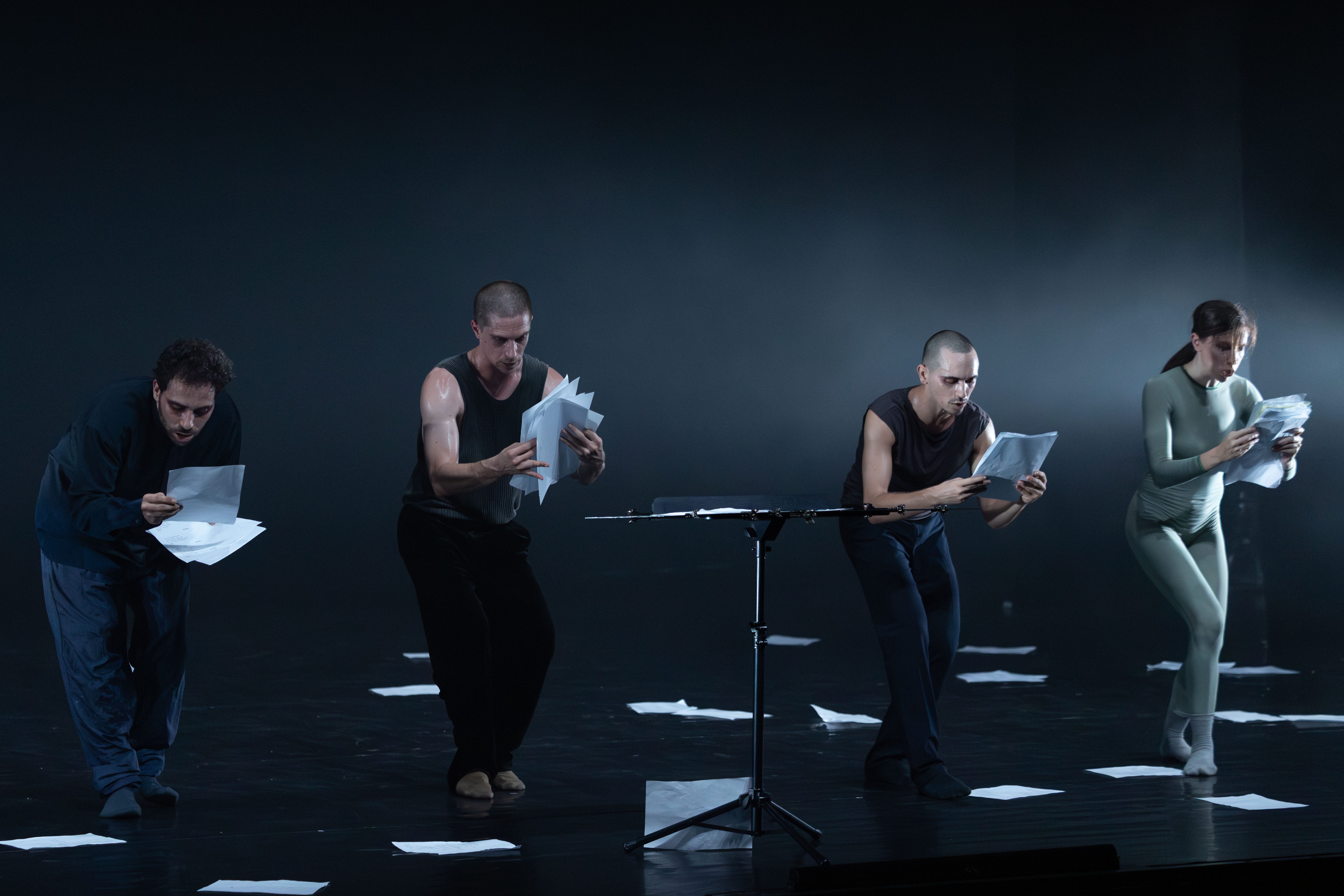
In Michael Getman’s Passion Is a Lonely Hunter, there were three men and one woman. The male dancers (Matan Cohen, Ori Mbazbaz, and Evyatar Omessy) were like polyglots. Their bodies seemed to contain multiple languages of dance. They moved fluently and fluidly from one dance language to another—ballet, hip hop, and probably a few others I didn’t recognize. On the evening of December 6, 2025, at Dellal Hall during the International Exposure dance festival, their energy was ferocious and wild, as if they were fueled by some force from the ground.
They not only danced. Vocally, they stuttered and repeated sounds, syllables, and words. Words in French and English, turning them from orderly languages into gibberish. They played with Shakespearean passages in ways that seemed mischievous and irreverent. They sounded rebellious, as if they were resisting against cultural domination of the West through language.
The lone female dancer, Bosmat Nossan, with her long brown hair that looked red under certain lights, stood in stark contrast to the male dancers, with their darker short or shaven hair. She wore a light-green full leotard, while the men wore looser-fitting pants and tops. Her movements and energy, too, were completely different from the rest of the ensemble. While there was something uncontained about her energy and her, at times, flailing arms and legs, her energy felt untethered—floaty rather than grounded like the men’s.
I was furious as I sat watching the performance. Why do only the men get to be funny and irreverent? Why are they the only ones who get to resist and rip apart the Western canon? Why doesn’t she get to be fluent in all these languages and dance forms? Why is her character so limited?
I was certain the lone female dancer represented the stupid white woman, the ignorant West, the bad Global North. And I was certain that the three men represented the good and rebellious Global South, resisting and tearing down the sacred Western canon.
Political buzzwords (decolonize, colonizer, white supremacy, diversity, equity, inclusion, intersectionality, patriarchy, toxic masculinity, structural racism, etc.)—which appear frequently in programs and exhibition notes of artistic spaces in Asia, Europe, and elsewhere—can rarely be found, if at all, in the International Exposure’s program. So I was also surprised that the festival chose Passion Is a Lonely Hunter to be one of its closing performance—a performance that espoused, as I believed in that moment, the sort of politics that is based on an intellectually lazy and morally juvenile premise that humankind could be easily categorized into the occupier and the occupied, the oppressor and the oppressed, the perpetrator and the victim.
At the same time, the quality of the dancing and the production design was undeniable. The dancing, the energy, and the atmosphere floored me. At the gut level, the piece hit me hard.
I spoke to a dance artist and academic soon after the show. She loved Passion… and didn’t see any problem with gender and racial representations like I did at all. I was surprised at her reaction to Passion… because in a previous conversation with her about a performance by a female choreographer at International Exposure, she had thought the piece was riddled with gender clichés and didn’t do sufficient work of resisting. I, on the other hand, didn’t see any gender-specific problems in that show at all and thought it had more to do with romantic and sexual relationships. I told her that perhaps this was because she was looking at women issues through solely academic lens. She reminded me that she was also an artist. (To be clear, I’m portraying these conversations from memory, so I may be getting some details wrong. Moreover, I always enjoyed conversations with this academic and artist during the festival.)
It turned out that I couldn’t have been more wrong about the politics of Passion…
When I read the program note, I realized that my interpretation of the piece was wide of the mark. Even before the artist’s statement, written by Getman and journalist and critic Merav Yudilevich, there is an excerpt from a poem, “Passionnément”, by the late Romanian surrealist poet Gherasim Luca. So that was where all the stuttering, repetition, and disassembling of words into syllables and sounds came from. As written in the statement, Getman and Yudilevich see “Passionnément” as a poem not to be understood “but a force to be experienced.”1
After reading Getman’s statement on his website, I discovered that politics doesn’t define his work. His interests are broader than that. One of the first sentences in the statement reads, “I create because I have to—or, rather, to understand my relationship to my own desire.” As I watched more clips of his work, I began to look back at those ferocious stutters and repetitions in Passion…less as a political act and more as expressions of desire. The dancing in Passion… wasn’t just fluent, fluid, and energetic, it was also passionate. The piece felt explosive not because it was a political statement, but because it was about passion, desire, and the passionate hunt that desire can set us upon—the perpetual state of being unfulfilled.
For some strange reason, I had projected the kind of politics I despise onto a performance whose aesthetic sensibility I admired.
I interviewed Getman in February over Zoom. As you will see in the interview below, I told him (very inarticulately) about my initial thoughts on his show and my mistaken interpretation of his work. He was curious about it and generous in his explanations. The choreographer also talked about the process of putting Passion Is a Lonely Hunter together, the limits of language, the boundlessness of the human body, how his work is political, and how it is not.
The interview has been condensed and edited.
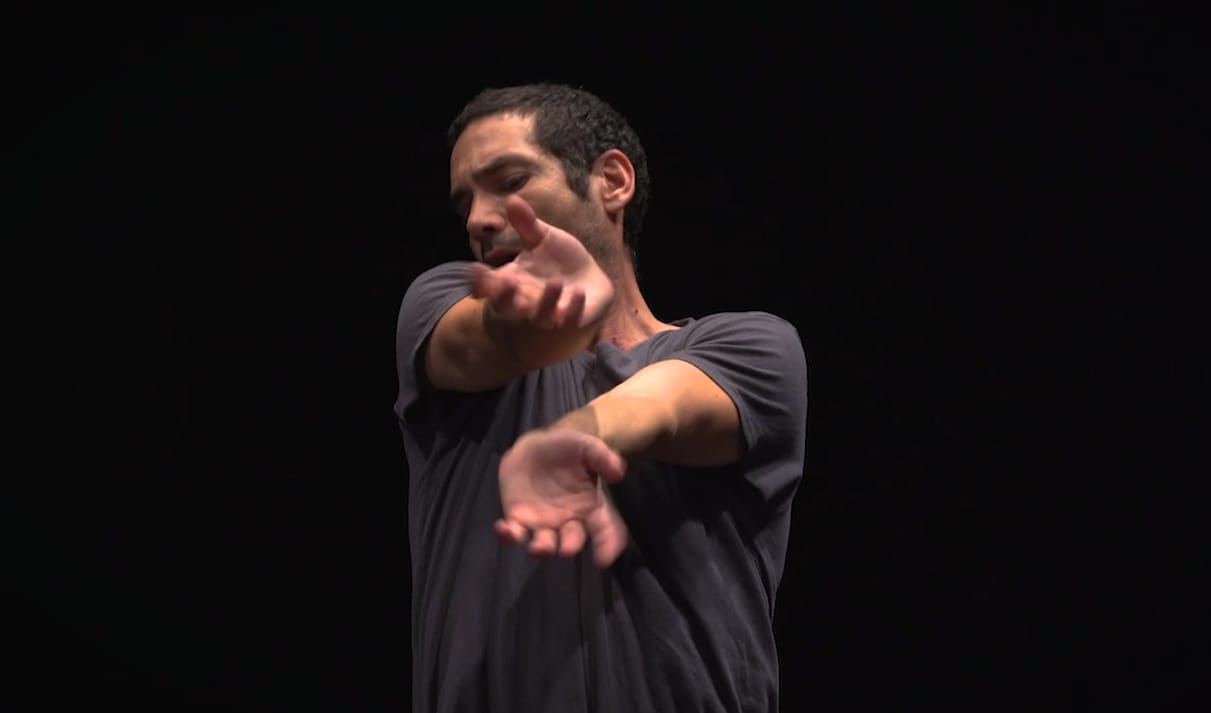
How did you come across Gherasim Luca’s poem, “Passionnément”, and what was your first impression of it?
I think I encountered him and this poem in a [piece] I was working on back in 2022, a solo work called First Things. And in this solo work, I was curious to handle and touch the construction and the relation between words, ideas, and gestures. And I came across him alongside other surrealist poets, like Gertrude Stein, that tapped into what I was looking at that time. And I was curious to find people who were working with the language from the perspective that words are more visceral, that words are almost a physical experience, and questioning words and language itself through words—deconstructing the language, asking about the meaning of language in different contexts.
I saw a short video of “First Things”. You were already working with something that appears in “Passion Is a Lonely Hunter”, like stuttering, the struggle to voice and [make sounds], or rhythmic stuff. But the poem itself didn’t enter yet in the same way.
No, the poem itself did not enter. Other people entered, like Gertrude Stein and Russian poet [Anna] Akhmatova. That time, I was writing my thesis, and what I was researching in my thesis was in relation to the philosophical work of Spinoza. For him, the word is not mental. It’s physical. So a lot of that entered the solo work. And later on, when I came to work on Passion Is a Lonely Hunter, I was opening my notebooks and my drafts, and suddenly, Gherasim Luca popped up.
Is it pretty usual for you or is it relatively new that your dance work or your choreographic work comes from or is inspired by text?
I would say it’s not new, but it’s not only coming from text or a poem. Maybe with the years, it became more specific and more diluted and directed toward that as a starting point. I’m creating an autobiographical solo work of a very renowned soloist/dancer, Talia Paz. She used to dance, for 20 years, with Mats Ek and [Birgit] Cullberg. And she approached me back in 2020 or 2021 with a proposition to create a solo work for her. It became an autobiographical solo work. She was commenting on what she can do today and what she cannot do today. She was also commenting on her past and choreographers she had worked with and how she translated that information into the present tense. And there, I started to work with her a lot on stuttering and utterance and words and narratives and where the threshold is when language becomes narration or when language is musical or when it’s becoming more physical.
For “Passion Is a Lonely Hunter”, could you talk about the choreographic process and the relationship between language and dance, particularly for “Passion…” Is it very different from “First Things”?
Yes, it is very different. First of all, it’s not a solo work. Solo work is its own world. I would say it’s kind of like a group piece. I had two subjects or engines: one was “Passionnément” by Gherasim Luca, and the other domain was the musical score by Luciano Berio, the Italian composer and conductor, called Sinfonia. In both those domains, the subject is, you could say, illusion or infatuation or love or passion or obsession—that state that puts us in denial of reality. In the musical score of Berio, the music is composed from many quotations that he cherished in his life as a composer. So this entire Sinfonia is composed of quotations from Bach, Mahler, Stockhausen, Beethoven, Stravinsky, as well as text from [Samuel] Beckett’s [novel] Unnameable, from Claude Lévi-Strauss, and other pieces of text I can’t recall now. And Sinfonia is the voyage for the unachievable. It’s a voyage for what happens when you’re on a voyage whose destination you know is unachievable. And I found a very interesting correlation to the poem of Gherasim Luca because you already know from the beginning you will not achieve what is desired, but you exist to attempt that.
Why did you decide to do a group piece for this one? And how did you decide the type of dancer, the number of dancers. How did that come about?
Well, first of all, certain ideas come out of necessity and demands. I was commissioned by the Suzanne Dellal Centre. I was an artist-in-residence, so I was commissioned to open the Tel Aviv Dance Festival. And they asked for a group piece. So that’s one thing. And I knew I wanted to do a group piece after… I had actually wanted five or six dancers, but we ended up with four, plus the structure onstage, the monolith. So you could say we are five up onstage. How did I come to find the dancers? Three of them I knew from previous encounters/works I created for a company. I also did a small audition.
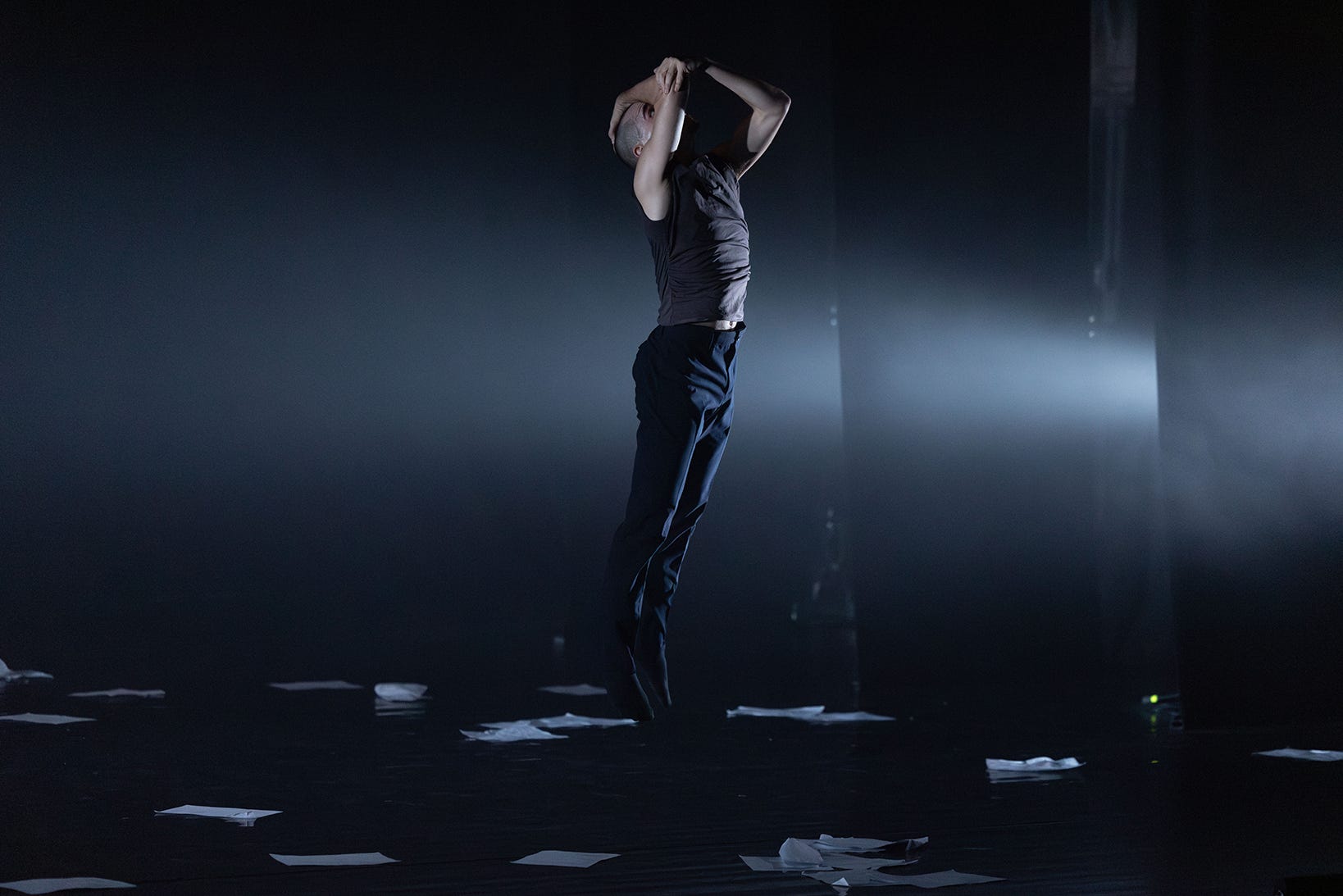
What kind of dancer were you looking for for this piece?
Most of the time, I look for people that are super curious, open-minded, who really, really know how to work: they really know the craft, but keep an open mind and can juggle and switch between different practices. There’s text, there’s coordination. And they [shouldn’t be] afraid to change.
When you auditioned, did you ask them to do certain voice work? I felt the voice work in the piece was also very intense. Did you choose dancers who also had certain vocal abilities?
Yes, we had one part of the audition where we were practicing the use of voice and the sense of musicality for the text, the capacity of association with the text, and the projection of the voice, of course. So we had a part of that in the small audition. And also, I had already known three of them and that they had experience with text in different frames, different styles.
I’m curious about the title as well because it’s so similar to that novel by Carson McCullers, “The Heart Is a Lonely Hunter”. Was that novel in any way an inspiration for this piece—its theme? Or do you just love the title, because it is a great title?
Yes, thank you. A little bit, a far, cloudy inspiration. Not direct. But of course, in the novel, there’s the illusion that love or passion puts us in a state of denial of reality. In the novel, we know that the [characters] are trying to find connection in the world, which is actually deaf.
I’m curious about the choreography as well. I went into the performance without reading anything about the show first. And I was just so impressed by the dancers. I felt they were just so fluent in many dance languages. I thought, “Oh, this is balletic, but also street dance.” Did you use a lot of dance languages in this?
First, it’s best to go in without reading anything first. That’s the best way. No, you’re absolutely correct. Because I also structured the piece alongside the musical score of Berio. And he’s using quotations. So I used a lot of different segments, different quotations, and different practices to have a sense of what language is. We used a lot of different styles. One of my assignments or my requests for the dancers, in the beginning while I was generating material with them, was to ask them, “What are you passionate about? From your childhood maybe? In dance? Or is it a physical practice?” So one of them said hip hop. And the other one said, “I came from folk dance—Israeli folk dance.” And the other one said, “I’ve always wanted to be a ballerina. I’m still a ballerina.”
But I also felt that the female dancer was so different in terms of her dancing. Was that partly what she decided to offer or propose in terms of her dance movement? Or was that something you wanted—to set her apart from the men?
All four of them are very different. They come from different practices. They have different experiences in their careers. Their interests are different. Their physiques are different. Their knowledge about themselves and about what it is to be a performer is different. I didn’t want to dilute that. I wanted to celebrate each one of them in their domain. And the woman, it’s the first time I worked with her. And she brought something that for me was also, What is that? What is that? And I kept that going instead of molding her into something that I would understand. I decided that I wanted to be the hunter here and tried to understand her basic physique because she does move in a very idiosyncratic way. Her movements are almost jerky. I never saw something like that. I got fascinated and decided to embrace that and deal with it—how to find harmony and disharmony with the rest.
Another thing was that, when I saw it, I loved the dancing and the visuals, but I also felt that it was a really political piece—the kind of politics that I see a lot in festivals in Asia or in Europe. I was kind of intrigued that I was seeing it in Israel as well. I thought that the male dancers represented the non-Western world, whereas the female dancer represented the Western world. And then when I read your program, I was like, “Oh, I’m completely wrong.” I suppose I just got used to certain ideas and certain politics that get presented in the international scene. And when I read more about your other work, I was like, “Oh, he doesn’t seem that political.” Politics is not your main thing. Could you talk a little bit about that maybe? I mean, obviously, I got some things super wrong.
I’m curious, what kind of politics did you see?
The politics of decolonization. The Western world, or the Global North, thinks [a certain way] about the Global South. And I just [thought], “Why is the woman being represented as this stupid white girl?” I thought it was so weird to be seeing this in Israel because I thought that this is not the kind of politics that Israel benefits from, this type of decolonial politics that you see in a lot of festivals and the arts now. This “We have to decolonize everything.”
Also in Asia?
Totally. Thailand was never a colony, but even then. [Some] countries are former colonies of France, England, [Portugal, and Spain]. While I was watching, I was like, “I love the dancing. I was just shocked to be seeing it in Israel because that’s what has really destroyed the discourse about the conflict between Israel and Palestine.” So I thought, “Is this really [the message]? Am I getting it right?” But when I looked at your website and program, I thought, “OK, you really don’t have this type of politics.” [The program] says nothing about politics or resistance.
No, no. The woman there is not the white trash. And the men are not the baboons [...] I don’t know how to… There is nothing about that there. I usually don’t do work to say something about something.
Right, to make a political statement.
No, no, no, no. If a political statement comes from the work, it’s because of a mixture of the practices of the work, the practices of the language of dance. Maybe something appears from there. For example, the work I did before that was a commissioned work [Two Wild Teeth] from the Inbal Dance Company a year ago. There was a person onstage. He handled the narration for almost the entire piece. He was reading a piece of text while the company was dancing. Some of the text was sometimes political, but not from the political domain. He was reading many quotations and many poetic works by poets and other writers—Oscar Wilde, for example, Yona Volak, a very famous Israeli poet, [Vladimir] Mayaskovsky, a Russian poet. Sometimes the political flair and flavor came out because of the use of the combinations of words and how you construct meaning and how you can construct, through language, meaning that suddenly can address for you as political, but for someone else not at all.
And isn’t that political? Aren’t we in that state of the power of the spectacle, the power of the image? Or when the image becomes more true, when the narration, the narrative becomes the absolute truth, then actually what is true? How do we narrate the story? For example, our situation here, the stories that we tell about our situation about Palestine, and the stories Palestine tells about the occupation, our occupation. Sometimes, I’m more interested in this kind of discourse in the political domain that looks at how things are being constructed through language. I would never put, maybe next work, yes, never say never, but it was never the intention to [talk about] the Global South and the Global North.
Or the occupier and the oppressed?
No. There was a moment of the occupier and the oppressed—and maybe you can read it in a political way—but there was a moment in the piece, which is the duet between a man and the lady. There is a duet there. And the man is speaking the text of Gherasim Luca, and the lady is falling all the time. And he needs to catch her. Now you might look at it as a man catching a lady—the prince is lifting the lady all the time. But you can actually look at it in the opposite way [as well], that she is falling and he’s doomed all the time to catch her, to support her. He has no agency.
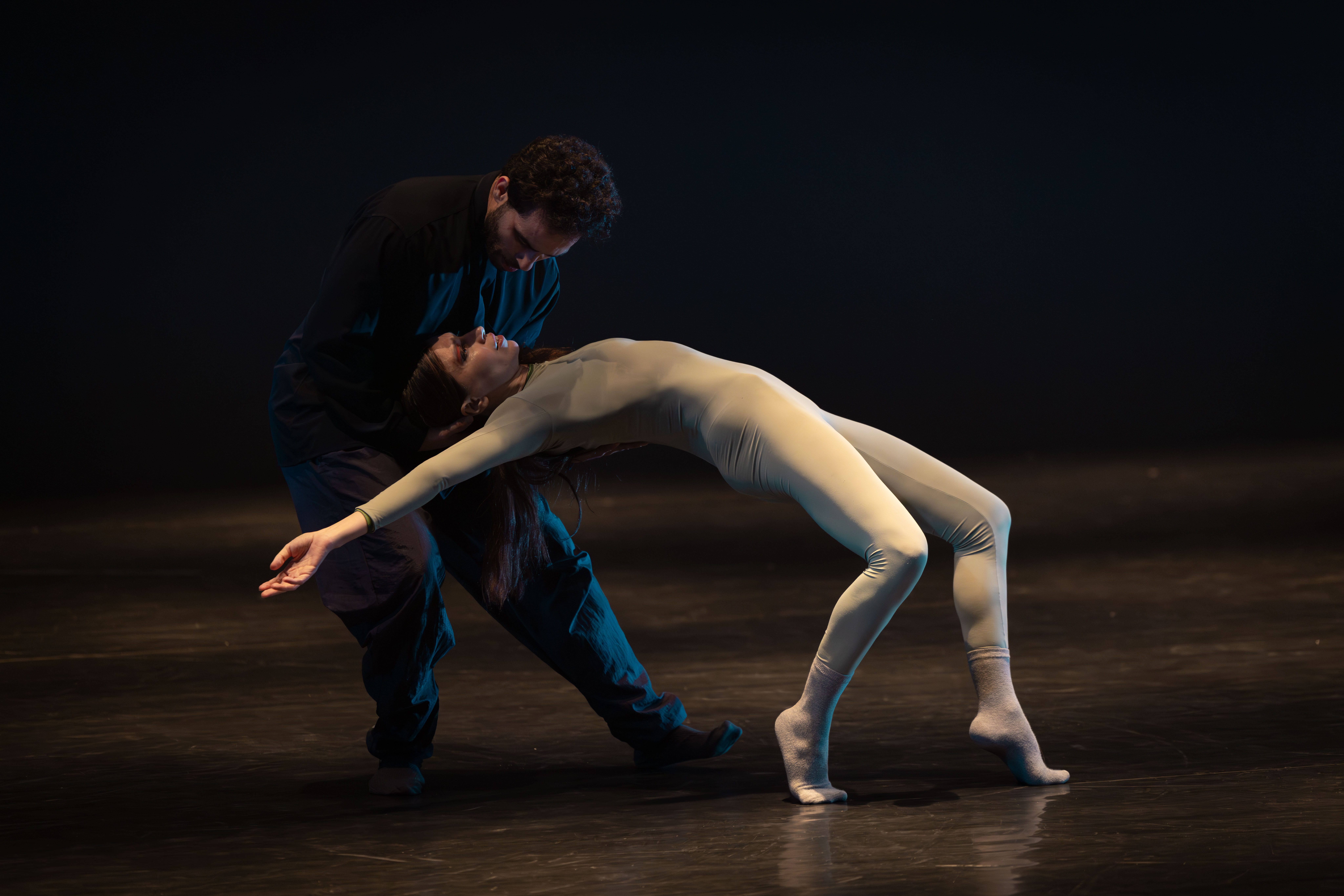
You’ve written that “language often falters before the complexity of our experience, pointing to what is missing, brushing against the shadow of an absent thing it represents.” What about dance and body and choreography, what are their limitations?
I think, well, who said that: “No one knows yet what the body can do.” Deleuze or Spinoza? I think in the domain of the body and physicality, we don’t know what the limitations are. And in the domain of choreography, I think limitations are what propel us to do them, to move forward, because there’s nothing more fascinating than to see, to sense a failure. And I think choreography has a lot to do with what we see. What keeps us fascinated by choreography is to see light and body onstage, to see how people and performers and human beings prevail in challenges, prevail in failures. That’s maybe why we’re fascinated by ballet, by all the bravura, by fouettés: because you can fail. And that’s the human part of it, what makes us fail is what’s so propelling. So I think the limitations are always there. And they’re exactly what open the road to creativity. In language, it’s quite obvious what the limitations are.
You don’t think language is something that can be pushed further? Or just not in the same way the body can be?
No, I don’t think that language is limited. I just think it’s coded. It’s specific in its coding. Language always points to something. It’s not the thing itself. It’s a signifier. It’s pointing. And once you say a word about something, you say the word. At the same time you speak about something, you’re also distancing yourself from the thing you’re speaking about. In that sense, language is clear in its limitations. But because it’s clear, it’s fascinating. And you can stretch it and push it. In the solo work, that’s the area where I was tapping, the zone between the thing and what we say about the thing. And to me, language is visceral. It’s physical. I look at it as flesh, as body, not necessarily as just residing in the mental [space], but something physical.
When it comes to literature, what is the kind of literature or text that really excites you as an artist?
Depends on the period, on how the text finds me. I’m very drawn to or find myself in my element when I feel the artist’s tools are language and words, but when I read their text, I feel a threshold of something they cannot achieve to say with their tools. I’m drawn to that sense where I feel language is fragile.
When it comes to the presence of language in dance, then, because dance is so abstract, how do you like to work with these two things? For someone like me, when I watch physical theater or dance or music, words become an anchor. An [the piece] becomes easier to access. Do you use language in that way? Or do you see it differently, the relationship between the two things?
I’m interested, first of all, in the relationship between words and actions, between gestures and ideas. I’m not the only one. And in that way, I’m interested in forms of communication. Dance is very abstract, but at the same time, it’s very concrete. And maybe that’s why it’s very difficult to grasp because it’s so close to us—bodies. We see bodies, humans. It’s so near us. It’s so us, and yet it’s so distant, foreign—what are they doing there onstage? It’s so familiar. It’s me, but it’s not me.
I’m interested very much in how things work, how they’re constructed, both language and language in dance. What makes a thing a thing? What are the conditions that need to happen in order for these things to be these things? In dance, I like to create a lot of layers so that maybe something will emerge out of these layers. It’s like a compost. So I’m very much interested in the practice itself of those things. The forces that constitute something. What constitutes a thing? What are the forces, the conditions that are there?
In terms of the stage and art, if I want to say something, it will never work if I really do it. I need to find it. I need to go around it. It’s like in movies, if you want to tell a joke, you don’t spoil it by being funny before you tell the joke. Or if you want to create suspense or fear, don’t show the monster. So it’s always the long way around.
As a choreographer, and I see that on your website, you write a lot. You have a separate section for your own writing. When you create a dance, how much does writing enter into it or is that a separate thing for you?
I usually write a lot before I enter the studio. And then I try to forget what I wrote. And then it meets me again in the later part of the process. So I read and write a lot before. And before I enter, I leave it aside. And then it comes back somehow—my writing, my thoughts—it comes back to the process somehow.
Do you [intentionally] find your way back there to review what you have written?
No, it meets us suddenly. Suddenly, I would realize, Oh, I didn’t go so far from what I had written in the beginning. Ah, no, it’s actually there, and it’s come back to us. Then we try going forward with it. Sometimes what I write can be very specific. But when I enter the studio, I want to forget about it because I don’t work with pages and words. I work with people. I want to discover and be with the people I collaborate with and not to be so didactic and or to keep [thinking], Oh, I wrote that, so it needs to be there. I need to work on that. No, throw it outside, and trust that what I was interested in will be there. And it’s always fascinating and nice to discover after a month or so, Oh, we’re there.
The paragraph was amended to include information about the program note and the artist’s statement.